
What Is Bespoke Market Research? A Complete Guide
Bespoke market research is research designed around a specific business question rather than a predefined methodology, audience, or report format. The research design changes according to what the business needs to understand, who can provide the evidence, and what decision will follow.
A standard market report may help a company understand an industry. It may not explain whether its own concept will appeal to buyers, why customers are rejecting an offer, or which route into a new market makes the most sense.
That is where bespoke research becomes useful. At PrizmData, our bespoke services are designed around the decision rather than fitting every project into the same research template.
What Is Bespoke Market Research?

Bespoke market research is a custom research program developed for a company’s particular market, product, audience, or strategic challenge.
Instead of beginning with a fixed questionnaire or research method, it begins with a business question.
For example:
- Which customer segment offers the strongest opportunity?
- Why are buyers choosing a competitor?
- Is there enough demand to enter a new market?
- Which product proposition should move into development?
- What prevents customers from adopting an existing product?
- How do different decision-makers influence a B2B purchase?
The research methodology is then built around the evidence needed to answer that question.
What Is Bespoke Market Research Used For?
Businesses can use bespoke research for decisions such as market entry, opportunity identification, concept validation, buyer exploration, category analysis, innovation planning, go-to-market strategy, and experience improvement. These are also among the applications covered by PrizmData’s current Bespoke services.
The purpose is not to make every research project complicated. It is to customize the parts of the study that need to reflect the company’s actual situation.
Bespoke Market Research vs Standard Research
Bespoke research and syndicated or predefined research serve different purposes.
| Area | Bespoke market research | Standard or syndicated research |
|---|---|---|
| Research question | Specific to the business | Designed for a wider audience |
| Target audience | Selected for the study | Usually predetermined |
| Methodology | Built around the question | Already established |
| Analysis | Focused on the company’s objectives | Follows a standard framework |
| Deliverables | Can reflect internal decision needs | Usually fixed |
| Best use | Specific strategic decisions | General market understanding |
A syndicated report may show that a market is growing or that consumer preferences are changing.
Bespoke research goes further when management needs to know what those changes mean for its own product, customer group, pricing, market-entry plan, or competitive position.
For a wider view of how research supports growth decisions, our guide on why market research is critical for business growth looks at the role of research across market understanding, customer insight, product development, and expansion.
What Methods Can Bespoke Market Research Use?
Bespoke does not describe one particular methodology. It describes how the research is designed.
Depending on the question, a study may use:
| Method | What it can help investigate |
|---|---|
| Qualitative research | Motivations, perceptions, objections, and decision processes |
| Quantitative research | Prevalence, differences between groups, and measurable patterns |
| B2B research | Organizational buying, stakeholder influence, and professional markets |
| Behavioral research | Actual actions and the gap between stated and observed behavior |
| Analytics research | Patterns within existing or newly collected data |
| Product research | Concepts, features, positioning, pricing, and customer needs |
PrizmData’s approach allows qualitative, quantitative, behavioral, and analytics methods to be integrated within one bespoke study where the business question requires them.
The strongest research design is therefore not the one with the most methods. It is the one that collects enough evidence to answer the decision properly.
How We Approach Bespoke Market Research at PrizmData
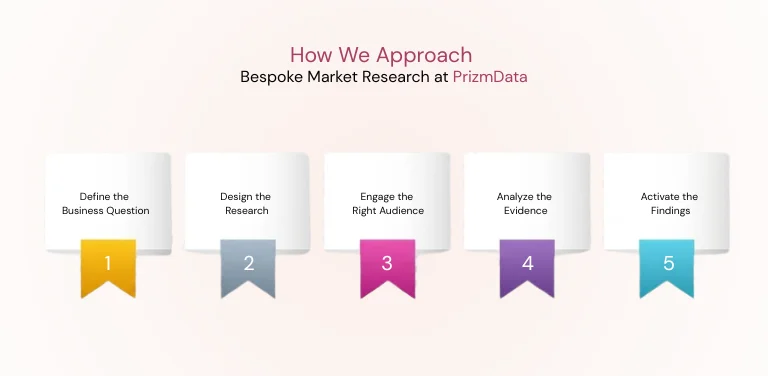
Our process moves through five stages: Define, Design, Engage, Analyze, and Activate. The stages keep the research connected to the original business problem from planning through application.
1. Define the Business Question
We first clarify the decision the research needs to support.
That includes identifying what is already known, where uncertainty remains, and what management needs to understand before taking action.
2. Design the Research
We then determine the methodology, sample, research structure, and analytical framework.
A project may require one method or several connected stages. The design depends on the question rather than a standard template.
3. Engage the Right Audience
Research quality depends heavily on who participates.
We identify the consumers, users, buyers, or B2B stakeholders who are directly relevant to the problem and screen participants accordingly.
4. Analyze the Evidence
Once the data is collected, we examine the patterns that matter to the business question.
That might mean comparing customer segments, exploring decision drivers, identifying barriers, or evaluating differences between markets.
5. Activate the Findings
Research only becomes useful when teams can apply it.
We connect the findings to decisions around products, markets, customers, innovation, or strategy so the output does more than describe what respondents said.
How Bespoke Research Supports New Product Decisions
Product development is one area where standardized research can quickly become limiting.
Suppose a team has three potential concepts. Management may need to understand whether customers recognize the problem, which proposition feels most relevant, where confusion appears, and whether one customer segment responds differently from another.
That could require exploratory qualitative research followed by new product concept testing across a broader sample.
Concept testing helps evaluate issues such as relevance, differentiation, purchase intent, value perception, and potential barriers before substantial development investment. PrizmData’s existing guide explains these stages and the different qualitative and quantitative methods that can be used.
Teams considering a new offer can go deeper into our guide to new product concept testing before deciding which concept deserves further investment.
Where Else Can Bespoke Market Research Be Used?
The same principle can apply across many business decisions.
Market Entry: A company may need to understand demand, competitors, buyer expectations, channel structure, and barriers before entering a country or category.
Customer Segmentation: Broad demographic groups may not explain why customers behave differently. Bespoke research can segment audiences around needs, behaviors, purchasing patterns, or decision criteria.
B2B Buying: Complex purchases may involve procurement teams, technical evaluators, senior management, and end users. Research can examine how their priorities differ and where influence sits.
Customer Behavior: What customers say they value may not always match what they actually choose. Research can combine reported attitudes with behavioral evidence to investigate that gap.
For a deeper exploration of this area, our guide to consumer behaviour research examines buying decisions, behavioral patterns, research methods, and common research questions.
Product and Pricing Decisions: Custom research can test product concepts, feature priorities, positioning, willingness to pay, and trade-offs before teams commit resources.
How Are Market Research Trends Affecting Bespoke Studies?

Current market research trends are expanding the range of tools available to researchers.
Businesses now have access to larger internal datasets, behavioral information, advanced analytics, digital research methods, and AI-assisted research workflows. These developments can make research faster or help teams examine questions that were previously difficult to study.
But new technology does not remove the need for good research design.
Teams still need to ask:
- Is this the right audience?
- Is the data relevant to the decision?
- Does the methodology answer the question?
- Are important customer groups being hidden by averages?
- What can the evidence support?
- What should happen next?
For bespoke research, new tools matter when they improve the quality or usefulness of the evidence. They should not determine the study simply because they are available.
A Simple Bespoke Research Example
Imagine a software company considering expansion into a new market.
Management initially asks: “Should we enter this market?” That question is too broad for one generic survey.
A bespoke study can break it into decisions:
| Business question | Research requirement |
|---|---|
| Is there a relevant customer opportunity? | Market and demand assessment |
| Which companies should be prioritized? | Segmentation |
| Who influences the purchase? | B2B stakeholder research |
| Which proposition resonates most? | Concept testing |
| What could prevent adoption? | Buyer interviews |
| How should the offer be positioned? | Integrated analysis |
Instead of producing unrelated datasets, the study connects each piece of evidence to the same market-entry decision.
That is one of the practical advantages of bespoke research.
What Should a Bespoke Research Project Deliver?
A custom study should not end with a large presentation full of disconnected charts.
The output should help the team understand:
| What the research found |
|---|
| Which findings matter most |
| How important groups differ |
| What evidence supports the conclusion |
| Where uncertainty remains |
| What the findings mean for the original business decision |
Depending on the project, PrizmData’s bespoke deliverables can include tailored insight reports, strategic frameworks, customer journey maps, dashboards, and decision-ready presentations.
Understand Bespoke Market Research
Bespoke market research ultimately means designing the research around the decision that needs to be made.
At PrizmData, we use bespoke research when a standard dataset or fixed methodology cannot provide enough context. The project may involve market entry, customer understanding, new product concept testing, B2B decision-making, or several methods working together.
As market research trends introduce new tools and data sources, the principle remains unchanged: use the method that gives the business the evidence it actually needs.
Frequently Asked Questions
Not necessarily. Cost depends on factors such as the target audience, number of markets, recruitment difficulty, methodology, sample requirements, and depth of analysis. A focused bespoke study may be smaller than a broad research program.
Yes. Qualitative research can first explore motivations, language, or barriers, while quantitative research can measure how widespread those findings are. The two methods can be combined when the decision requires both depth and scale.
Consider bespoke research when existing information cannot answer a company-specific question, when the audience is specialized, or when a strategic decision requires evidence from several sources or methods.