
Why Market Research Is Critical for Business Growth in 2026
Market research is the fundamental step towards smarter business decisions. It gives you an edge over your competitors, helps you identify your audience, market trends, and potential risks in business.
Whether you are scaling your business, launching a new product, need insights on market trends, or are facing trouble retaining your audience, thorough market research is the solution for you.
Let’s understand why it is significant to conduct market research and how a market research company can help you grow your business in 2026.
What is Market Research?
Market research is essentially a systematic process of getting to know the market. It provides clear insights on market conditions, trends, opportunities, and risks to help a business take informed and data driven decisions.
Systematic market research provides you the intelligence to make an actionable roadmap for the future. It involves in depth interviews, surveys, reviewing industry reports, competitive analysis and other market research methods to gather data and insights.
Businesses invest in research to gain data-driven intelligence, derive practical insights, and take measurable actions based on evidence.
Why Market Research Matters More in 2026
Most industries feel noisier than they used to. More options. More messages. More competitors claiming the same benefits. And customers who can switch faster than ever.
That is what makes market research critical in 2026. It helps you understand what is actually changing, versus what just looks like change on the surface.
A few examples you have probably seen:
- People say they want “premium”, but still abandon carts when pricing feels unclear.
- A competitor launches something new, and suddenly everyone assumes the market has shifted.
- Customer feedback sounds positive, but retention still drops month by month.
In each case, the business problem is not lack of effort. It is lack of clarity. Market research gives you that clarity before decisions turn into expensive experiments.
How Market Research Drives Business Growth
Market research supports growth because it improves the quality of decisions. Not in a motivational way. In a practical way. It helps you focus on what will actually move the business forward.

1. Clearer Customer Understanding
Most brands think they know their audience. And they usually know the basics.
But what changes over time is the reason people choose you, or stop choosing you. That shift can be subtle. Research helps you catch it early.
It can show you:
- What customers truly care about when they compare options
- What makes them hesitate at the last moment
- What they consider “value” in your category
- What they tolerate, and what they will not
This kind of understanding makes your marketing sharper, your product decisions cleaner, and your customer experience more realistic.
2. Better Product and Service Decisions
A lot of product decisions are made with good intentions and incomplete information.
Research helps you validate ideas before you commit fully. It helps you avoid building things customers politely ignore.
Depending on your goals, research can support:
- Concept testing before launch
- Feature prioritisation based on real demand
- Understanding what people use repeatedly versus once
- Identifying friction points that push customers away
Even small insight here can save months of work later.

3. Stronger Positioning Against Competitors
Competitive research is not only about tracking what others are doing. It is about understanding what the market believes.
Sometimes the real competitor advantage is not their product. It is perception. They feel more trusted. More established. Easier to work with. More “safe”.
Market research can help you answer:
- Why people choose competitor brands, in their own words
- What customers believe your brand stands for today
- Where competitors are strong, and where they are vulnerable
4. Smarter Expansion and Growth Bets
Growth often means expansion. New region. New segment. New offering.
This is also where assumptions get risky. What works in one geography or segment does not always translate. Even simple things like pricing tolerance, trust expectations, and buying process can shift.
Market research helps you assess:
- Real demand signals, not just internal excitement
- Market readiness and adoption barriers
- Competitive saturation
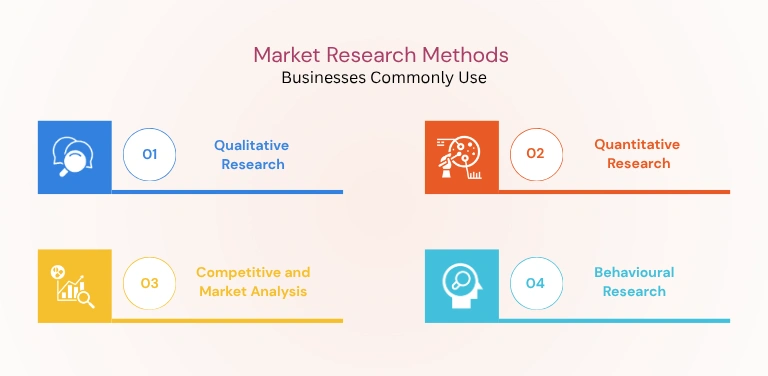
Market Research Methods Businesses Commonly Use
There is no single “best” method. The method depends on the question. A strong market research company will usually recommend a mix.
Qualitative Research
This is where you go deep and understand the reasons behind behaviour.
Methods include:
- In-depth interviews
- Small group discussions
- Stakeholder conversations
Qualitative research is useful when you want to understand motivations, hesitations, decision logic, and emotional drivers.
Quantitative Research
This is where you measure patterns at scale.
Most commonly through surveys, it helps you quantify:
- Preferences and choices
- Willingness to pay
- Segment sizes
- Awareness and perception
- Usage frequency and behaviours
It is useful when you need confidence and proof, not just direction.
Competitive and Market Analysis
This is typically used to map the landscape:
- Market structure and key players
- Category trends
- Differentiation gaps
- Benchmarking positioning and claims
It works well when you are planning strategy or entering new spaces.
Behavioural Research
Behavioural research focuses on what people actually do in real workflows, not what they say they do.
It is useful when you want to understand:
- Adoption and repeat use patterns
- Decision chains inside organisations
- Real friction points in journeys
- Trust signals that drive or block usage
This is often where the most honest insight comes from.
When Should You Invest in Market Research?
Some businesses treat research as something you do before a big launch. That is one use case. But research is just as valuable when you are trying to fix what is already live.
You should seriously consider market research when:
- You are launching or repositioning a product
- Growth has slowed and the reason is unclear
- Customer churn is rising
- A competitor is gaining share and you do not know why
- Pricing conversations keep getting stuck
- Marketing is busy, but pipeline quality is slipping
If your team is debating the same questions repeatedly, that is usually a signal that you need evidence.
What a Market Research Company Adds
It is possible to run small research projects internally. Many teams do. And for quick feedback, that is fine.
But structured market research is different. It requires:
- Clean sampling (so you are hearing from the right people)
- Strong questionnaire and discussion design
- Reliable data quality checks
- Analysis that connects the dots instead of listing findings
A market research company brings that structure. It also brings neutrality, which matters when you need alignment across leadership, product, and commercial teams.

Bottom Line
Market research is a practical tool for growth. It helps you understand customers better, improve product decisions, strengthen positioning, and reduce risk when you scale. Most importantly, it gives your team clarity, so decisions are based on evidence, not guesswork.
Frequently Asked Questions
1. How does research help businesses make better decisions?
It gives businesses reliable insights into customer preferences, market conditions, competitors, and emerging opportunities. This helps teams validate ideas, reduce uncertainty, prioritise investments, and make decisions based on evidence rather than assumptions.
2. What market research methods can businesses use?
Common market research methods include qualitative research, quantitative research, competitive and market analysis, and behavioural research. The right combination depends on the business question and research objectives.
3. How can a market research company help a business?
A market research company provides structured research through appropriate sampling, research design, data quality checks, and analysis. It also offers an objective perspective that helps businesses turn research findings into practical growth strategies.