
What Is Analytics Research? Guide to Data-Driven Business Decision-Making
Analytics research is the structured use of data to answer a defined business question. It helps teams move beyond reporting what happened and examine what is driving a result, how patterns differ across groups, and what the evidence suggests they should investigate next.
Businesses already collect data through surveys, CRM systems, sales records, digital platforms, and customer interactions. The challenge is deciding which information is useful for the decision at hand.
At PrizmData, we start with the business question. We then determine what data can answer it and how that evidence should be analyzed.
What Is Analytics Research in Business?

Analytical study or research combines business data with analytical methods to identify patterns and support decision-making.
The data may already exist within the organization, or it may come from new primary research. In some projects, we combine both.
To understand what is analytical research, here is an example: a dashboard may show that sales declined by 8%. Then an analytical study asks:
- Which customers account for most of the decline?
- Did one product category perform differently?
- Did the pattern begin after a pricing change?
- Is the decline temporary or recurring?
- What additional evidence do we need before acting?
The objective is not to create more reports. It is to narrow the problem until the team understands what deserves attention.
What Is It Used For?
Businesses can use it to investigate questions around:
- customer churn
- pricing performance
- market segmentation
- product usage
- sales trends
- campaign performance
- demand forecasting
- customer lifetime value
The right analytical approach depends on the question rather than the amount of data available.
Why Does Analytics Research Matter?

Having more data does not automatically lead to better decisions.
For us, the important point is not simply whether a company uses analytics. It is whether that analysis helps answer a real business question.
A team may have several dashboards and still not know:
- why one customer group is leaving faster than another
- whether a promotion improved demand enough to justify the margin impact
- which product feature influences preference most strongly
- whether an apparent market trend is relevant to its own audience
A Practical Way to Think About Analytical Study
Different questions require different levels of analysis.
| Approach | Business question | Example |
|---|---|---|
| Descriptive | What happened? | Which customer segment recorded the largest decline? |
| Diagnostic | What appears to be associated with it? | Did the decline coincide with a change in usage or pricing? |
| Predictive | What is likely under similar conditions? | Which customers show a higher probability of churn? |
| Prescriptive or scenario-based | What could we do next? | How might revenue change under a different pricing approach? |
We do not treat these as a ladder where every project must reach the most advanced stage.
Sometimes a clear descriptive comparison is enough to solve the problem.
How We Approach Analytics Research at PrizmData
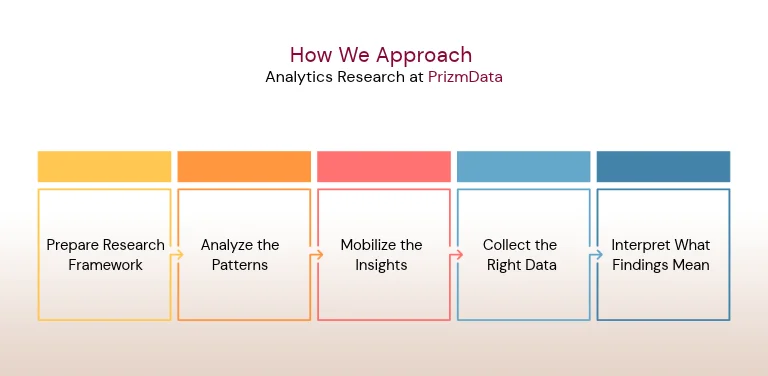
Our research starts with the business question and ends with findings that teams can actually use. We move through five stages: Prepare, Collect, Analyze, Interpret, and Mobilize.
1. Prepare the Research Framework
We first define what the business needs to understand and which outcomes matter.
This means setting clear objectives, identifying relevant KPIs, and deciding what the analysis needs to answer. Starting with the decision keeps the project focused and prevents teams from analyzing data simply because it is available.
2. Collect the Right Data
Once the objective is clear, we bring together the information needed to investigate it.
Depending on the project, this can include survey responses, transaction records, CRM data, digital engagement data, or other structured and semi-structured sources.
The priority is not collecting as much data as possible. We need data that is relevant to the question and reliable enough to support the analysis.
3. Analyze the Patterns
We then apply the analytical methods that fit the research objective.
This may involve regression analysis, clustering, predictive modeling, multivariate testing, or visual analytics. We choose the method based on what the business needs to learn rather than using a complex technique simply because it is available.
For example, segmentation may help us identify groups that behave differently, while predictive modeling can help estimate the likelihood of a future outcome.
4. Interpret What the Findings Mean
Analysis gives us patterns. The next step is understanding what those patterns mean for the business.
We connect the results back to the original question and examine what they suggest for areas such as customer strategy, product decisions, pricing, or operations.
We also remain clear about what the evidence can and cannot prove. A relationship between two variables may be useful, but it does not automatically establish cause.
5. Mobilize the Insights
The final stage is about making the findings usable.
We translate the analysis into clear recommendations and identify what the business should consider next. That could mean refining a product strategy, reassessing a customer segment, testing a pricing decision, or identifying where further research is needed.
The goal is simple: the analysis should make the next business decision clearer.
How Analytical Study Supports B2B Research
B2B research often involves long buying cycles and several people influencing the same decision.
Analytics can help us see whether different account types behave differently.
For example, we might compare:
- deal length by company size
- purchase criteria by buyer role
- product usage across account groups
- renewal rates by customer profile
If one type of account consistently takes longer to convert, that gives the B2B research team a more specific issue to investigate.
Analytics shows us where the pattern sits. Research with decision-makers can then help explain what is happening behind it.
To understand how businesses evaluate suppliers and make purchase decisions, read our detailed guide about what B2B research is and its importance for businesses.
How Analytical Study Strengthens Product Research
Product Research produces information about concepts, pricing, feature preferences, and user needs.
Analytics helps us understand the trade-offs inside that information.
Suppose customers rate six proposed features highly. Those scores alone may not tell the product team what to build first.
A stronger research design can examine what customers choose when they cannot select everything. We can then compare those preferences across user groups or test how willingness to pay changes.
Common Mistakes To Avoid

Starting With the Tool: Wanting a predictive model is not the same as having a research question. We define the problem before choosing the method.
Trusting Poor-Quality Data: A larger dataset does not fix inconsistent or missing records. We check the data before interpreting the results.
Treating Correlation as Cause: Two variables moving together does not prove that one caused the other. We separate association from causal evidence.
Looking Only at Averages: Overall performance can hide meaningful differences between customer groups. We break the data down when the decision requires it.
Producing Analysis Nobody Can Use: A technically strong model has limited value if the business cannot connect its output to an action. The final result should make the decision clearer.
When Should a Business Use Analytics Research?
Analytical study becomes useful when a report identifies a problem but does not explain it.
It is particularly relevant when:
- several explanations could fit the same result
- customer groups appear to behave differently
- management needs to compare possible scenarios
- B2B Research produces patterns that need deeper analysis
- Product Research generates data that needs further interpretation
- teams have large datasets but no clear path from information to action
Sometimes analytics provides the answer directly.
In other cases, it tells us which research question should come next.
So, What Is Analytics Research Really For?
Ultimately, it comes down to using data to make a business question easier to answer.
At PrizmData, we use analytical research to identify patterns, test assumptions, and support clearer decisions. It can strengthen B2B research or help product research teams interpret complex customer evidence.
The goal is not more analysis. It is better evidence for the next decision.
Frequently Asked Questions
They overlap, but analytical study begins with a defined research or business question. Data analytics describes the broader examination of data, while research adds the decision context and interpretation.
Yes. CRM records, transaction data, survey results, and product usage information can all support analysis. We first check whether the available data is suitable for the question.
There is no universal minimum. The requirement depends on the question and the method being used. A smaller, well-structured dataset can be more useful than a much larger dataset with major quality gaps.