
What Is B2B Research and Why Your Business Can’t Ignore It in 2026
B2B research (Business-to-Business research) involves the systematic process of collecting and analysing information about businesses, professional buyers, and business markets. It focuses on organisational buying and decision-making processes.
In B2B environments, purchasing decisions are never made by one person alone. The technical team may look at compatibility, procurement may negotiate the terms of purchase, and management will make sure that the investment is relevant to business goals.
Different people see different values.
And here arises the question of how businesses will create their product, their message, and their strategy based on actual buyer needs, rather than assumed needs. Here is where B2B research comes in handy.
It will help you understand your business buyers, decision makers, market opportunities, competitive positioning, and factors driving purchase decisions. It will help transform disorganised feedback and market signals into structured insights, allowing for sound decision-making.
In this guide, we will discuss B2B research, its differences from market research, methodologies involved, and the ways working with a professional market research agency will help you minimise risks and capitalise on growth opportunities.
What Is B2B Research?
B2B research involves studying the decision-making process for purchases, evaluation of solutions, vendor interaction, and reaction to the changing market conditions.
Unlike consumer research, which focuses on personal preferences and actions, B2B research concentrates on organisational decision-making.
The task is not to just ask organisations what they need but to understand their full decision context:
- Who are the people who affect the purchase?
- What is the business problem they are trying to solve?
- What criteria decide which vendors to choose?
- What barriers stand against adopting new solutions?
- Why do customers remain loyal, switch or abandon their current supplier?
- How are the various solutions viewed by the market?
For example, an organisation selling enterprise software might assume that advanced product features are key for potential buyers.
However, research may show that complex implementation is what stands in the way of adoption.
This shifts the strategy from just highlighting product features to the implementation and onboarding experience.
This is the true value of B2B research – understanding the logic behind decisions.
Why B2B Research is More Relevant Than Ever in 2026

Business markets are rapidly evolving. Consumers have more knowledge, choices, and demands.
Opinions or past results of strategies that rely exclusively on them will not be able to see changes in consumer behavior.
Consumers Are More Independent Before Interacting With Sales Representatives
The classic B2B buying process has become different. Research shows that 69% of the purchase process happens before buyers engage with sellers, while 81% of buyers already have a preferred vendor before the first interaction. That means businesses have fewer chances to shape consumers’ initial impression.
B2B research is necessary to find out:
- What information do consumers need
- What issues arise during evaluation
- What messages build credibility
- What proof points affect confidence
B2B Decisions Involve Multiple Stakeholders
A major challenge in B2B markets is that the person using a product is not always the person approving the purchase. Research shows that buying groups for complex B2B decisions can include 6 to 10 stakeholders, making it essential for businesses to understand different priorities across the decision-making process.
A typical buying group may include:
| Stakeholder | Primary Focus |
|---|---|
| End User | Ease of use and daily workflow impact |
| Technical Team | Integration, security and scalability |
| Procurement | Cost, contracts and supplier reliability |
| Leadership | Business value and long-term impact |
A message meant for just one group may end up missing some other groups that are also part of the final decision process.
B2B research assists in mapping these groups and learning what drives them.
Competition Is Rising In Most Categories
Most categories of B2B marketing have become highly competitive.
Companies provide the same benefits, same messages, and the same positioning.
Phrases like these are common in all B2B fields:
- “Make you more efficient”
- “Save you money”
- “Fuel your growth”
- “Help you make smarter decisions”
The problem is not necessarily standing out, but understanding what is relevant.
B2B research helps in understanding:
- What benefits buyers appreciate the most
- What messages seem credible
- Where the competition wins
- Where buyer needs are underserved
B2B Research vs Traditional Market Research
Although both approaches aim to understand markets and customers, the focus and complexity are different.
| Traditional Market Research | B2B Research |
|---|---|
| Studies consumers and individual behaviour | Studies organisations and professional decision-making |
| Often focuses on preferences and attitudes | Focuses on business needs, priorities and outcomes |
| Purchase decisions may involve one person | Multiple stakeholders influence decisions |
| Emotional and personal factors can dominate | ROI, risk, efficiency and business impact play major roles |
| Customer journeys are often shorter | Evaluation cycles are usually longer and more complex |
For instance, a consumer opting for an app could give preference to convenience and design.
When a company selects enterprise software, some of the factors that could be considered include:
- Security requirements
- Effort required for implementation
- Capabilities of integration
- Cost-effectiveness
- Approval process internally
It is such differences that necessitate specialised research techniques in the B2B environment.
What Questions Could Be Answered Using B2B Research?

The usefulness of B2B research lies in the answers it provides to business questions.
Understanding Buyers
Some of the questions that can be answered by B2B research include:
- Who are involved in the buying process
- What are the obstacles impacting purchase behavior
- What are their expected outcomes
- Why they don’t choose any particular solution
Understanding Markets
It is important for any company to have an understanding prior to entering a new market or offering a new product.
Research can assist in understanding:
- Market demand
- New customer needs
- Level of competition
- Opportunities for growth
- Potential barriers
This would enable businesses to understand the opportunities available before investing heavily in them.
Understanding Competition
A competitive analysis is not always about feature comparison.
B2B research looks into:
- Perceptions of competitors by the buyer
- The reason customers opt for other alternatives
- The areas in which competitors foster better trust
- Market gaps
Understanding Customer Retention
Converting customers may be easy. What’s important is how you retain the customer in the long run. Research can help companies find out:
- Reasons for customer loyalty
- Factors that affect customer satisfaction
- Challenges faced during adoption and expansion.
Types of B2B Research Studies Used by Business Organisations
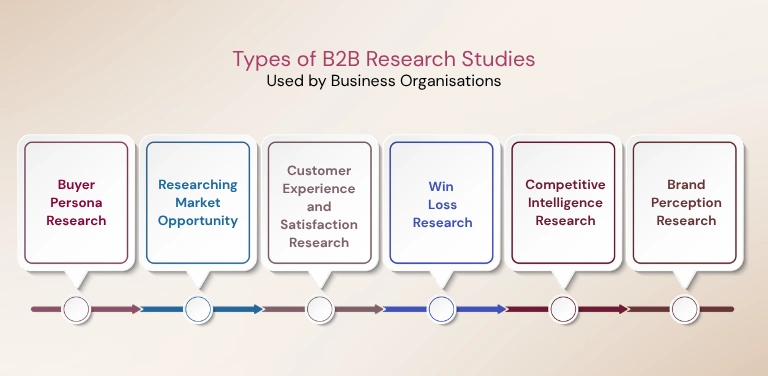
B2B research is not a singular type of research. Different types of studies may be required depending on the nature of the business decisions needing support.
A business looking into a new market will need different perspectives than a business seeking customer retention or discovering reasons for missed sales opportunities.
The best types of B2B research services should be focused on meeting the goals of the businesses rather than conducting generic information gathering.
Buyer Persona Research: Unraveling the Decision-Maker’s Mind
Organisations tend to create their own ideal customer persona from the perspective of the size of the organisation, industry, sales figures, or job titles alone.
However, such aspects do not reveal much about how purchase decisions are made.
Buyer persona research is furthered by gaining insights into:
- Who are the people influencing the decision
- What issues do they face
- What metrics are used to measure them
- What influences their recommendation process
- What fears keep them from making a move
For instance, a company offering cybersecurity products may start with targeting IT heads as their key audience group. However, later on, it might be found out that even though IT professionals spot the issue, finance professionals control the budget allocation, and compliance professionals decide on vendor selection.
Researching Market Opportunity: Locating Opportunities for Growth
To enter a new market, it is not enough to simply spot a prospective client base. A company must figure out if the opportunity is viable from a business point of view.
Market opportunity research can be used to study:
- Consumer demand
- Market maturity
- Competitive environment
- Emerging trends
- Adoption challenges
- Unmet needs
This is particularly useful if a company plans to:
- Enter a new industry
- Develop new products
- Enter new geographic markets
- Consider investment opportunities
Without making any presumptions, an organisation can find out if there are conditions for growth.
Customer Experience and Customer Satisfaction Research: The Study of What Drives Retention
Customers do not just become satisfied and move away after their purchase. In B2B environments, retention can rely on ongoing value creation, experience, usage, and business results.
Customer research reveals:
- What is most important for a customer
- What experience does not deliver
- Why does the client stay and extend his or her deal with you
- What makes him or her annoyed
- What improvements are really needed
A customer can keep using your solution despite having problems with operations.
Win Loss Research: Understanding Sales Results
Results of sales have much to teach us, yet most organisations merely record whether they won or lost the sale.
The purpose of win-loss research is the exploration of reasons for the win/loss outcomes.
Such research enables one to understand:
- Why did the customer choose our competitor?
- What were the determining factors?
- Was price, function, credibility, or relationship responsible?
- Were there any holes in our selling process?
- What was our position relative to other options?
Competitive Intelligence Research: Getting the Picture on Position
It’s not just about the products being compared in competition. Firms need to know how buyers see various options within the marketplace.
Competitive intelligence research can help by providing insights into:
- Competitive strengths and weaknesses
- Perception gaps in the marketplace
- Pricing perceptions
- Opportunities for differentiation
- Changes in buyer preferences
Brand Perception Research: Measuring Market Reputation
The way a firm views its own brand might be very different from its reputation in the marketplace.
Brand perception research can assist in measuring:
- Brand awareness in target markets
- Brand credibility
- Buyer trust
- Competitive positioning
- Brand associations with key characteristics
B2B firms especially need to consider reputation in their marketing strategy because the buyers are putting a lot on the line when they buy.
What is the Process for B2B Research?

A good B2B research process is one that doesn’t start with answering questions, but rather with defining the problem that needs to be solved.
Good research always begins with determining the problem that must be solved and picking the right approach to solve it.
The typical B2B research process includes the following steps:
Step 1: Setting up the Research Objective
The initial step in conducting the research involves understanding the business issue that has prompted it.
A well-defined objective would provide guidance on:
- The information required
- The stakeholders to be involved in the research
- The research methodology to adopt
- The application of research outcomes
For example:
Poorly defined objective: Find out reasons for non-purchase of our product by customers.
Better defined objective: Find out what factors are stopping mid-market technology firms from using our solution and compare our positioning vis-à-vis our competitors.
The latter approach is a more precise way of setting up research direction.
Step 2: Identifying the Right Audience
B2B research will always depend on having the right respondents.
In contrast to the case of consumer research, which could use demographic information or general interests for targeting, B2B research will require a deeper knowledge of professional roles and decision influence.
The target audience for the research can include such people as:
- Leaders of companies
- Heads of departments
- Procurement specialists
- Technical evaluators
- Current clients
- Previous clients
- Industry experts
And it is necessary to know that different people might have different reasons for their decisions.
For instance, when considering a software platform, a business leader might be more concerned about its influence on growth, a financial team – about its efficiency, a technical team – about its compatibility, and an end-user – about its usability.
Step 3: Choose the Correct Research Methodology
There is no one-size-fits-all research methodology for B2B. The correct choice depends on the question to be answered.
For example:
Qualitative interviews can be effective in understanding customer motivations.
Quantitative surveys can be validated if there is a need to measure market demand.
Benchmarking research is essential if there is a need to analyse competitive positioning.
An effective B2B research services provider will choose a methodology based on the decision outcome and not just the easiest way to do it.
Step 4: Data Collection via Structured Research
With the methodology in place, data collection proceeds.
This involves planning for the following:
- Selection of respondents
- Formulation of a questionnaire
- Formation of interview questions
- Quality control of data
- Validation of responses
Improperly formulated questions can lead to flawed findings even if the right people are being surveyed. For instance, posing the question, “Would you be willing to purchase such a solution?” could result in favourable answers.
A better approach to research is through questions about:
- The issue is solved by the product
- The existing alternatives
- The issues that may inhibit the adoption of the solution
- What factors would determine the decision-making process?
Step 5: Analyse Findings Beyond Surface-Level Results
Data alone does not create business value.
The real challenge is identifying patterns and understanding what those patterns mean.
Strong B2B research analysis looks at:
- Differences between customer segments
- Variations across industries
- Stakeholder priorities
- Buying barriers
- Competitive perceptions
For example, an overall finding may show that buyers value efficiency.
However, deeper analysis may reveal:
- Enterprise customers prioritise scalability
- Smaller businesses prioritise affordability
- Technical teams prioritise reliability
These differences create more actionable strategies than average results alone.
Step 6: Convert Insights Into Action
The final stage of research is applying the findings.
Research should influence decisions such as:
- How a product is positioned
- Which customer segments to prioritise
- How sales teams communicate value
- Which features should be developed
- Where new market opportunities exist
A research report that is stored but never applied creates limited value.
The purpose of B2B research is not documentation. It is better decision-making.
B2B Marketing Research Mistakes To Avoid

A properly constructed research project can help companies derive greater value from their investments.
Researching Only Current Customers
Current customers can provide great insight but represent only a fraction of the marketplace.
By limiting communication to only current customers, a company is at risk of missing:
- Reasons why prospects prefer competitors
- Reasons why adoption doesn’t take place
- Shifts in expectations
- The needs of potential customers
A holistic approach usually involves conversations with customers, prospects, missed opportunities, and members of the marketplace.
Questions for Confirmation of Existing Ideas
Good research questions must serve to challenge ideas rather than confirm them. The main error here is framing the questions based on the ideas a company holds.
For instance, rather than asking: “How useful do you find our advanced analytics functionality?”
It would be better to ask: “Which capabilities are important in choosing an analytics platform?”
Looking Only at Average Results
Averages can hide important differences. A finding such as: “70% of buyers value flexibility” may seem useful.
However, segmentation may reveal:
- Large enterprises value flexibility because of complex operations.
- Smaller companies value simplicity because they have limited resources.
Without segmentation, businesses may develop strategies that satisfy no specific audience.
Treating Research as a One-Time Activity
Markets change constantly.
Customer priorities, competitor positioning, technology adoption, and economic conditions continue to evolve.
Regular research helps businesses identify:
- Emerging customer expectations
- Changing market dynamics
- New competitive threats
- New growth opportunities
Research should be viewed as an ongoing source of market intelligence rather than a one-time project.
Should You Use an In-House Team or a B2B Market Research Company?
Many organisations can conduct basic customer research internally. However, complex business decisions often require deeper expertise, broader access, and an independent perspective.
A specialised B2B market research company can provide:
Research Objectivity
Internal teams naturally have assumptions about their products and customers.
An external research partner brings neutrality by approaching the study without internal bias.
Access to Relevant Audiences
Finding the right B2B respondents can be challenging, especially for:
- Niche industries
- Senior decision-makers
- International markets
- Technical audiences
Experienced research companies have established approaches for identifying and reaching relevant participants.
Structured Methodologies
Professional researchers understand how to design studies that produce reliable insights.
This includes:
- Selecting appropriate methods
- Developing effective questions
- Ensuring response quality
- Analysing findings correctly
Strategic Interpretation
Raw findings do not always provide clear direction.
A strong research partner helps connect insights with business decisions by identifying:
- What matters most
- What actions should follow
- Where opportunities exist
- Which risks need attention
Conclusion: Crafting Strategies Based on Market Realities
For any B2B growth, it is crucial to comprehend the organisations and individuals who make every decision.
As a business makes decisions based solely on assumptions, there are risks of investments in the wrong markets, development of the wrong features, and even communication of value that buyers don’t recognise. B2B research replaces the guesswork with structured insights.
It gives insight into the decision-making process, buyer influences, market opportunities, and impact-generating actions.
The most effective strategies in 2026 will not be about louder messaging and more assumptions; they will be about market comprehension.