
Retail Price Competitiveness: What We Learned Beyond Selling Price
Within every organisation, pricing is a significant topic of discussion. Products feel overpriced. Competitors seem cheaper. Discounts feel necessary but never quite sufficient.
Over time, these conversations tend to loop. The same questions come up. The same fixes get suggested. And yet, the underlying tension often remains.
That was one of the starting points for a retail price competitiveness study carried out for Dubai Economy & Tourism (DET). As a market research company in Dubai, PrizmData analysed how pricing was actually behaving across the market and what those patterns revealed about competitiveness.
The study covered hundreds of key value items across luxury, premium, and mass-market brands, spanning categories. Prices were tracked across multiple benchmark markets and reviewed over several years. The intent of the market research was simple: to understand the patterns.
The Opportunity: Why Price Competitiveness Needed a Deeper Look

Dubai’s retail market operates at a scale where intuition alone stops being reliable. Global brands sit side by side across segments. Consumers move easily between channels. Tourists bring their own reference points, often shaped by what they paid in entirely different markets just weeks earlier.
In this kind of environment, pricing can look competitive on paper and still feel misaligned in reality. A price gap might seem small internally, but noticeable to a visitor comparing across countries.
Many traditional pricing exercises struggle here. Shelf prices are easy to compare, so they tend to dominate analysis. Snapshots are quick to produce, so they get used repeatedly. Category averages offer comfort, even when they hide more than they reveal.
The opportunity behind this behavioural research study was to move past those limitations. Instead of asking which brands were overpriced, the more useful question was whether pricing challenges were short-term reactions or signs of deeper structural misalignment. That distinction changes how decisions are made.
The Solution: Rethinking How Pricing Was Analysed

To get there, the analysis had to slow down a little.
Rather than treating pricing as a fixed comparison, it was looked at as something that evolves. As a market research company in Dubai, PrizmData approached the study by analysing discount-adjusted prices, category movements, brand tiers, and benchmark markets to understand what pricing behaviour was actually signalling.
Categories and brand tiers were examined separately. This sounds obvious, but it makes a big difference. Pricing behaves very differently in luxury compared to mass-market retail. Lumping them together tends to blur important signals.
Time was another key element. Looking at one month or one quarter can be misleading, especially in markets where promotional calendars drive a lot of movement. Tracking prices over multiple years made it easier to see what corrected itself naturally and what kept coming back. One data point can raise a flag. Patterns tell you whether something is actually wrong.
The Impact: What the Analysis Made Visible
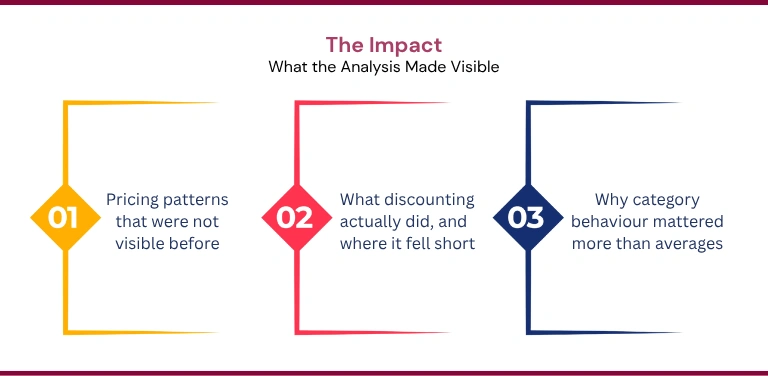
Pricing patterns that were not visible before
Once pricing was viewed across categories and over time, some patterns became hard to ignore.
In several categories, a sizeable portion of brands continued to price above benchmark markets, even after discounts were factored in. Apparel and toys stood out here more often than others. In contrast, parts of electronics showed quicker adjustment when competitive pressure increased.
Brand tiers also behaved differently. Certain luxury and premium tiers showed consistency year after year. Meanwhile, parts of the mass segment moved around much more, sometimes without any obvious trigger. That volatility itself became informative. It suggested uncertainty rather than strategy.
What discounting actually did, and where it fell short
One thing the market research data made clear is that discounting is not a guaranteed fix.
In some segments, it worked. Discounts helped close gaps, and pricing settled back into a competitive range. These segments generally showed clearer positioning and stronger discipline.
In other areas, discounting acted more like a temporary cover. Prices slipped out of alignment again once promotions eased. Over time, this created a rhythm where promotions became expected rather than purposeful.
Across years of data, this behaviour repeated often enough to point toward deeper issues, such as:
- Positioning that didn’t fully match what consumers expected
- Uneven discipline across brand tiers
- Promotions being used to compensate for misalignment
Discounting was not the problem here; it was the over-reliance on it.
Why category behaviour mattered more than averages
Another insight that kept resurfacing was how uneven category behaviour really was.
Some categories moved within a fairly tight band. You could see logic in how prices responded to pressure. Others were far less predictable. Prices shifted frequently, sometimes for reasons that weren’t immediately clear.
When everything is rolled into an average, this difference disappears. Category-level analysis brought it back into focus, and with it, a better understanding of where pricing could realistically be managed and where deeper questions needed to be asked.
What Changed in Decision-Making Conversations

This shift is where the role of a market research company in Dubai becomes valuable. By turning scattered pricing observations into structured insights, research helps teams move from broad assumptions to specific decisions backed by evidence.
Once pricing patterns were laid out clearly by category, brand tier, and discount-adjusted pricing, conversations started to sound different.
Earlier discussions often stayed broad. “We’re expensive.” “Competition is undercutting us.” They described a feeling, but not a direction.
With clearer patterns in front of them, teams could ask more useful questions:
- Which categories stayed misaligned even after repeated promotions
- Which brand tiers actually moved back into range when discounts were applied
- Where discounting helped, and where it simply delayed the issue
- Which segments showed stability, and which ones kept shifting
This didn’t magically solve everything, but it did make prioritisation easier. Some issues pointed to positioning. Others to channel execution or promo discipline. And importantly, it became clear that not every pricing issue needed the same response.
How A Market Research Company In Dubai Helps Decode Market Behaviour

Price competitiveness is not really about being cheaper. It’s about being aligned with how the market works and what consumers expect in that space.
In the DET price competitiveness study, the real value came from looking at pricing as behaviour over time, not as isolated comparisons. That shift helped separate short-term noise from patterns that were clearly structural.
As a market research company, this is the kind of work we focus on. Not producing more data for its own sake, but helping teams see what the market is actually doing and decide what to do next with a bit more confidence.
Frequently Asked Questions
1. How did PrizmData approach the retail price competitiveness study?
We analysed pricing across categories, brand tiers, benchmark markets, and time periods, using discount-adjusted data to distinguish temporary movements from persistent pricing gaps.
2. What made PrizmData’s approach different from a standard pricing comparison?
We moved beyond shelf-price snapshots and examined pricing behaviour over time, helping us uncover recurring patterns, category differences, and the actual impact of discounting.
3. How can PrizmData’s market research support better pricing decisions?
We turn complex pricing data into actionable market intelligence, helping teams identify where intervention is needed, where promotions work, and where deeper structural issues exist.