
What is Competitive Intelligence? How it Helps Businesses Make Better Decisions
Businesses rarely make decisions in isolation. Competitors change prices, launch products, enter new markets, adjust messaging, and respond to changing customer expectations.
Competitive intelligence helps businesses understand those movements in context. It involves gathering and analyzing information about competitors, customers, market conditions, and other external signals so teams can make better-informed strategic decisions.
At PrizmData, we use research and analysis to move beyond simply tracking what competitors are doing. The objective is to understand what those changes mean for the business and where they may create a risk, opportunity, or need for further investigation.
What Is Competitive Intelligence?

Competitive intelligence is the structured process of collecting, analyzing, and applying information about the competitive environment to support business decisions.
Useful intelligence may cover:
- competitor products and services
- pricing and positioning
- new launches
- market expansion
- customer perceptions
- partnerships and distribution
- industry trends
- regulatory or technology changes
- changes in buyer expectations
The goal is not to collect as much competitor information as possible. It is to identify the signals that are relevant to a specific business decision.
Competitive Intelligence vs Business Intelligence
| Area | Competitive intelligence | Business intelligence |
|---|---|---|
| Main focus | External market and competitive environment | Internal business performance |
| Typical data | Competitor activity, market movements, customer signals, industry information | Sales, operations, finance, CRM, and performance data |
| Core question | What is changing around us, and what could it mean? | What is happening inside the business? |
| Common use | Positioning, market entry, product strategy, competitive response | Performance management, forecasting, operational decisions |
The two can work together. Business intelligence may show that sales have weakened in one category. Competitive research can then examine whether competitor pricing, new offers, changes in distribution, or shifts in customer expectations may be contributing to the pattern.
What Information Goes Into Competitive Intelligence?
Competitive intelligence can draw from both primary and secondary research.
Relevant sources may include:
- competitor websites and product information
- company announcements and financial filings
- industry reports
- customer reviews
- pricing and promotional activity
- distributor or retailer feedback
- interviews with customers or business buyers
- market surveys
- trade events and industry publications
- regulatory information
Ethical competitive intelligence relies on legally and appropriately obtained information. It is not corporate espionage.
The challenge is usually not finding information. Businesses often have more information than they can use. The harder task is determining which signals are credible, relevant, and important enough to influence a decision.
Competitor Monitoring Is Only the Starting Point
Competitor monitoring means systematically tracking changes in competitor activity.
A business might monitor:
- new products
- pricing changes
- website messaging
- promotions
- partnerships
- hiring activity
- geographic expansion
- distribution changes
This creates useful visibility, but monitoring alone is not intelligence.
If a competitor changes its price, the observation itself does not explain why the change happened, whether customers care, or whether another business should respond.
Competitive intelligence adds analysis.
Teams need to ask:
- Is this an isolated change or part of a wider pattern?
- Which customer group could be affected?
- How does the change compare with category trends?
- Does it alter the competitor’s positioning?
- What evidence is needed before responding?
Effective competitor monitoring therefore provides signals. Analysis turns those signals into competitive insights.
How Does Competitive Intelligence Improve Business Decisions?
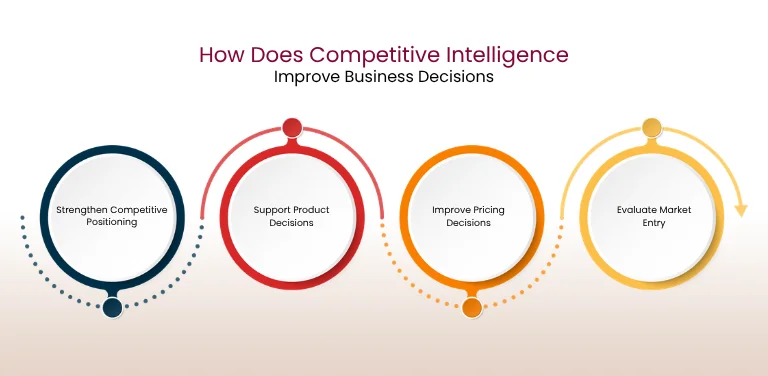
1. Strengthen Competitive Positioning
Businesses need to understand how customers compare available options.
Research can examine competitor claims, product benefits, customer perceptions, and gaps in existing offers. This helps teams determine where their own positioning is genuinely different and where several competitors are making similar promises.
Competitive insights can also show whether differentiation that appears strong internally is meaningful to customers.
2. Support Product Decisions
Product teams can use competitive intelligence to understand how other companies are responding to changing customer needs.
This does not mean copying competitor features.
Instead, research can examine:
- which customer problems competitors are addressing
- how products are packaged
- what benefits are emphasized
- where customers remain dissatisfied
- how competing propositions are changing
That evidence can complement product research by showing the wider market context around customer needs and product decisions.
3. Improve Pricing Decisions
Competitor prices are useful reference points, but price comparison alone can be misleading.
Businesses also need to understand product mix, promotions, positioning, perceived value, and differences between markets.
PrizmData’s retail price competitiveness study is a useful example of why competitive analysis needs more context than a simple price comparison. The research examined pricing patterns across markets and categories to understand what those patterns revealed about competitiveness.
For a deeper look at this approach, read our guide to retail price competitiveness: Retail Price Competitiveness: What We Learned Beyond Selling Price
4. Evaluate Market Entry
Before entering a market, businesses need to understand more than market size.
Competitive intelligence can help examine:
- which competitors are established
- how the category is structured
- what customers currently choose
- how products are positioned
- where distribution or procurement barriers exist
- which market spaces appear crowded or underserved
These competitive insights give market-entry research a clearer picture of the environment a new offer will have to compete within.
What Is Competitive Marketing Intelligence?
Competitive marketing intelligence focuses specifically on how competitors compete for customer attention and demand.
It can examine:
- positioning and messaging
- campaign themes
- promotional activity
- channel strategy
- content priorities
- customer responses
- changes in brand communication
The objective is not to reproduce another brand’s marketing.
Competitive marketing intelligence helps teams understand which claims are already common in the category, how competitors communicate value, and where messaging risks becoming indistinguishable.
Marketing teams can then use that evidence alongside customer research to develop positioning grounded in both customer needs and competitive context.
Turning Market Signals Into Competitive Insights

The value of competitive intelligence comes from interpretation.
A useful process starts with a clear decision: What are we trying to understand?
Research can then identify the information needed, compare sources, examine patterns, and assess what the evidence means for the business.
At PrizmData, several research approaches can contribute to this process. Our B2B research offering includes competitive intelligence, competitor analysis, market sizing, product-market fit validation, pricing assessment, and buyer journey mapping.
Quantitative research can support competitor benchmarking and trend analysis, while analytics research can identify trends, benchmark performance, map risks and opportunities, and evaluate different scenarios.
The research approach depends on the decision rather than treating competitive intelligence as a single standardized method.
Competitive Intelligence in the Market Research Agencies Industry
The market research agency industry also relies on competitive intelligence to keep pace with changing methodologies, client expectations, emerging research technologies, and shifts in how evidence is collected and interpreted.
For research agencies, competitive intelligence can support areas such as:
- competitive benchmarking
- category intelligence
- market trend tracking
- changes in consumer behavior
- emerging research methods
- evolving client requirements
At PrizmData, we support research teams with competitive benchmarking, category intelligence, consumer behavior signals, and market trend analysis that can strengthen existing research workflows.
The aim is to provide clearer market context while allowing agencies to retain ownership of their research strategy, interpretation, and client relationships.
Avoid Turning Competitive Intelligence Into Data Collection

One of the easiest mistakes is treating more information as better intelligence.
A large competitor database has limited value if teams cannot determine:
- what has actually changed
- why the change matters
- which evidence is reliable
- whether action is required
- what additional research is needed
Regular competitor monitoring should therefore be connected to defined business questions.
The strongest competitive intelligence does not simply tell a team what competitors have done. It helps determine whether those developments should change the company’s own strategy.
Use Competitive Intelligence to Make Better Decisions
Competitive intelligence gives businesses a structured way to understand what is changing outside the organization and what those changes could mean for strategy.
It combines competitor monitoring, market evidence, customer research, and analysis to produce competitive insights that can support product decisions, pricing, positioning, market entry, and B2B strategy.
At PrizmData, we focus on connecting external market signals with the business question that needs to be answered. The objective is not simply to know more about competitors. It is to know which evidence should influence the next decision.
Frequently Asked Questions
Competitor analysis usually focuses on evaluating specific competitors, such as their products, positioning, pricing, or strengths and weaknesses. Competitive intelligence is broader because it can also include customers, market trends, industry changes, and other external signals that influence competition.
The frequency depends on the market and the decision. Fast-moving categories may require ongoing competitor monitoring, while strategic market reviews may happen at defined intervals. The priority is to monitor signals that could materially affect business decisions rather than track every competitor activity.
Yes. B2B competitive intelligence can examine competitors, buyer expectations, procurement requirements, decision-maker priorities, product-market fit, pricing, and account-level dynamics. This helps businesses understand both who they compete against and how organizations evaluate competing solutions.