
Inheritance Decisions And Wealth Transfer Patterns Study
Inheritance is not about numbers on a statement. On paper, inheritance looks like a transfer. In reality, it is a period of decision. Some people move quickly. Others hesitate. Some build plans. Others avoid them. And many sit somewhere in between.
This study was designed to understand inheritance decisions and wealth transfer beyond the movement of assets. How high-net-worth individuals manage inherited wealth. How they think about passing it forward. And where advice, emotion, and uncertainty shape outcomes more than spreadsheets do.
The Opportunity: Clarity In A High-Stakes Transition
There is a lot of talk about the coming wave of intergenerational wealth transfer. The scale is real. But scale does not tell you how people behave once they receive assets.
Some inheritors feel pressure to do the right thing immediately. Others feel unsure about what the right thing even is. Some look for guidance straight away. Others rely on instinct, family input, or simply time.
For the client, the opportunity was not to confirm that wealth is transferring. That part is obvious. The real opportunity was to understand:
- What do inheritors actually do first?
- When do they seek advice?
- What makes them plan early, and what makes them delay?
- How clearly do they communicate future intentions?
Because without those answers, advisory strategy tends to be built on what should happen, not what actually does.
The Core Challenge: Inheritance Is Not Just Financial
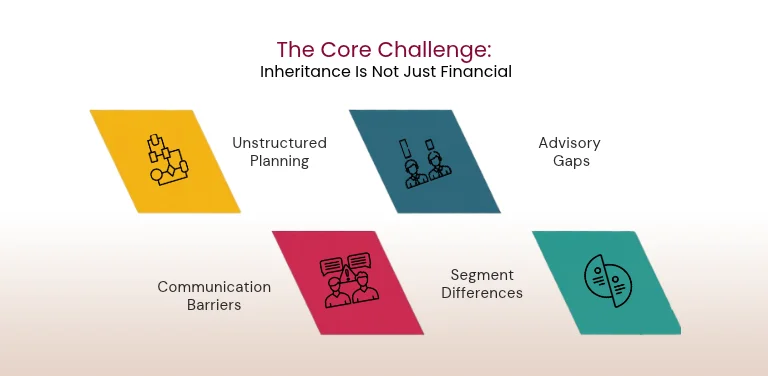
Inheritance decisions are financial, yes. But they are also personal. And that makes behaviour less predictable.
Across markets, we saw a few consistent tensions.
Unstructured Planning
Many inheritors do not begin with a clear plan. They may have goals in mind, but not a defined structure for allocation, reinvestment, or redistribution.
Sometimes planning is delayed because it feels emotionally heavy. Sometimes because there are too many options. And sometimes because everything seems “fine for now.”
The absence of structure is rarely laziness. It is often uncertainty.
Advisory Gaps
Some individuals involve advisors early and actively. They want structure, reassurance, or a second opinion.
Others either delay advisory engagement or treat it as a formality. In some cases, family voices carry more weight than professional ones. In others, trust in advisory relationships is still developing.
Advice can shape outcomes meaningfully. But only when it enters the picture at the right moment.
Communication Barriers
Inheritance planning involves conversations people often avoid.
Even when someone has clear legacy intentions, they may not communicate them openly. It feels sensitive. Or premature. Or uncomfortable.
But silence creates assumptions. And assumptions create friction later.
Segment Differences
Not all high-net-worth individuals approach inheritance in the same way.
Some are plan-driven. Some are reactive. Some are comfortable talking about legacy early. Others postpone until a life event forces clarity.
Treating them as one group oversimplifies the reality.
Our Approach: Behavior-Centered Wealth Research

Our approach to inheritance decisions and wealth transfer focused on how decisions unfold in real life, rather than treating inheritance as a purely financial event.
The focus was on how decisions unfold in real life.
As a market research company, our role was to keep the research centered on those real decisions rather than assumptions about how inheritors should behave.
Study Focus
We examined:
- How inherited wealth is allocated
- What drives those allocation decisions
- When and how advisors influence outcomes
- How legacy planning intentions are formed
- How and when communication happens
Rather than looking at inheritance as a single event, we looked at it as a sequence of decisions that evolve over time.
Analytical Lens
We segmented findings across:
- Demographics
- Wealth profile
- Planning maturity
- Advisory engagement
That segmentation made a difference. Because the “average inheritor” does not really exist. What exists are clusters of behaviour that reflect different levels of confidence, urgency, and structure.
What The Study Revealed

Several patterns stood out.
Inherited Wealth Feels Different
People often relate to inherited wealth differently than wealth they earned themselves.
Some feel protective. Some feel responsible. Some feel cautious. That emotional framing changes allocation behavior. It is not purely rational. And it is not purely emotional. It is a mix.
Advisory Influence Depends On Timing And Trust
Advice can be decisive. But only when trust is present and the timing feels right.
In some segments, advisors help translate uncertainty into structure. In others, advice enters too late or not at all. Expertise matters. But alignment matters just as much.
Planning And Communication Do Not Always Move Together
Some individuals plan privately but delay telling others. Others communicate intentions loosely without formal structure. This gap between planning and communication is where misunderstandings often emerge.
Legacy Planning Is Often Triggered, Not Continuous
Many individuals do not treat legacy planning as an ongoing process. They act when something triggers urgency. A milestone. A family change. A shift in responsibility. Waiting is common. And that waiting shapes advisory opportunities.
Business Impact: From Generic Advisory To Segment-Specific Strategy
The study gave the client clarity that was hard to get from high-level wealth transfer narratives.
It helped identify:
- Distinct behavioral segments among inheritors
- Where advisory engagement is strongest and where it is missing
- Communication gaps in legacy planning
- How planning maturity differs across profiles
Instead of approaching inheritance as a uniform event, the client gained a behavioral map. That changes positioning, messaging, and how and when to engage.
Some segments need structure quickly. Others need confidence before structure. Some need guidance on allocation. Others need help starting the conversation. That nuance is where strategy becomes useful.
Closing Thought
Inheritance is not just about assets moving. It is about people adjusting. Adjusting to responsibility, a new financial reality, and conversations they may not feel ready for.
This study brought that adjustment period into focus. Not as a theory. But as observable behavior. When strategy reflects how people actually navigate inheritance, it becomes more grounded and more relevant.
Frequently Asked Questions
The study was designed to understand how high-net-worth individuals manage inherited wealth, what drives their allocation decisions, when advisors influence outcomes, how legacy intentions develop, and how those intentions are communicated.
The findings were segmented across demographics, wealth profile, planning maturity, and advisory engagement. This helped identify different patterns among inheritors rather than treating high-net-worth individuals as one uniform group.
The appropriate market research methods depend on the business question and the evidence required. Research may need to explore decision drivers, compare patterns across groups, or use Data Collection & Analytics to organize and interpret complex findings. A market research company should select the approach according to the decisions the study needs to support.