
How Businesses Use Consumer Insights to Improve Products
A product team may know that customers are abandoning a feature, choosing a competitor, or asking for an improvement. The harder question is why.
Consumer insights turn customer data, feedback, and behavior into an explanation that teams can use. They help businesses understand what people need, what influences their choices, where products create friction, and which improvements are worth pursuing.
At PrizmData, we connect these insights with product research throughout the development journey, from understanding the problem and testing concepts to evaluating features, pricing, user experience, and go-to-market decisions.
What Do Consumer Insights Tell Product Teams?

Consumer insights are interpretations drawn from customer evidence that explain why a behavior, preference, or problem matters to a business decision.
Customer data and insights are not the same thing. Data alone does not always provide that explanation.
Product usage might show that customers are not engaging with a particular feature. Research is needed to determine whether the issue relates to awareness, usability, relevance, or another factor.
Useful insights can help teams understand:
- problems customers are trying to solve
- unmet or poorly served needs
- reasons behind product choice
- barriers to adoption or continued use
- features customers value most
- differences between customer groups
- how stated preferences compare with actual behavior
The value comes from connecting the finding to a decision rather than collecting more information for its own sake.
How Do Consumer Insights Improve Products?
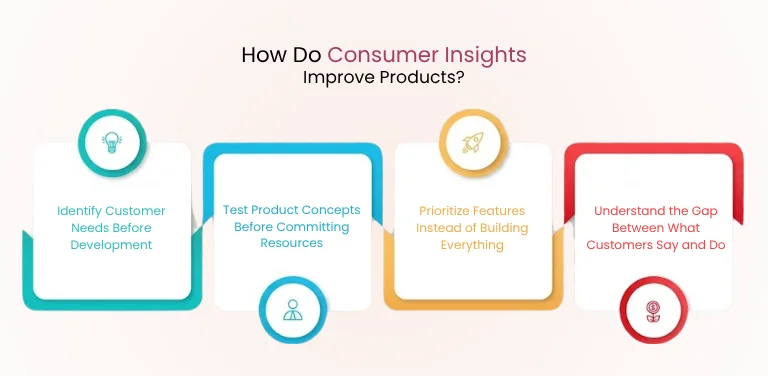
1. Identify Customer Needs Before Development
Product improvement starts with understanding the problem customers experience.
Qualitative research can explore motivations, frustrations, expectations, and the context in which customers use a product. Interviews, focus groups, and observational approaches allow researchers to follow up on issues that a closed-ended survey may not fully explain.
At PrizmData, qualitative work is used across areas such as product concept exploration, customer journeys, idea validation, and post-launch experience research.
These insights can help product teams distinguish between a requested feature and the underlying need behind that request.
2. Test Product Concepts Before Committing Resources
An internally promising idea still needs to make sense to the intended customer.
Concept testing can investigate:
- whether the proposition is understood
- which benefits customers and is considered relevant
- what creates hesitation
- how customers compare alternatives
- whether positioning needs refinement
- which concepts deserve further development
This is an important part of product research because problems identified early are easier to address than issues discovered after development.
Our product research approach includes concept screening, prototype feedback, product-market fit validation, pricing and value testing, and go-to-market alignment.
3. Prioritize Features Instead of Building Everything
Customers can find several features appealing at the same time. Product teams still need to decide where development effort should go.
Research methods such as feature prioritization, MaxDiff, conjoint studies, prototype interviews, and structured surveys can help compare preferences and trade-offs. These methods are also part of PrizmData’s current product research capabilities.
The purpose is not to build every feature customers mention. It is to understand which capabilities address important needs and which are most relevant to product choice or use.
4. Understand the Gap Between What Customers Say and Do
Self-reported feedback is valuable, but it does not always capture actual behavior.
A customer may express interest in a feature but rarely use it once the product becomes part of everyday life. Similarly, someone may describe a process as straightforward while their actions reveal repeated friction.
Behavioral research helps investigate these gaps by examining observed behavior, engagement patterns, decision triggers, habits, and barriers.
Our behavioral approach specifically looks at differences between stated intent and actual customer choices, using methods that can include experiments, field studies, tracking, and behavioral analysis.
This evidence can help teams improve product experiences based on what customers actually do rather than relying only on what they report.
Different Research Methods Answer Different Product Questions
No single method produces every useful consumer insight.
| Research approach | What it helps explore | How it supports product decisions |
|---|---|---|
| Qualitative research | Motivations, needs, perceptions, and context | Explore problems, concepts, and experiences. |
| Quantitative research | Patterns, preferences, and differences between groups | Measure and compare findings at scale. |
| Behavioural research | Actions, triggers, habits, and friction | Understand actual usage and adoption. |
| Consumer behavior research | How and why customers make choices | Explore purchase, usage, and switching decisions. |
| B2B research | Organizational buying and stakeholder influence | Understand products sold to business customers. |
| Product research | Concepts, features, pricing, usability, and fit | Guide product decisions across development. |
The methods can also complement one another. For example, qualitative research may reveal several reasons customers struggle with an experience. Quantitative work can then assess how those issues vary across a wider audience, while behavioral evidence can examine what happens during actual use.
Consumer Behavior Research Adds the “Why” Behind Choice
Improving a product requires understanding more than the product itself. Businesses also need to understand how people evaluate options and make decisions.
Consumer behavior research examines how customers choose, use, switch, and respond to products or services. It can explore the influences behind purchasing and help explain why seemingly similar customers make different choices.
That perspective is useful when businesses are evaluating positioning, customer journeys, adoption barriers, or changing preferences.
For a deeper look at this area, our guide to consumer behavior research explains the methods and questions used to examine customer decision-making.
Customer Insights Matter After Launch Too

A launch creates new evidence. Businesses can begin examining actual product usage, adoption, repeat engagement, support issues, cancellations, and reactions to new features or updates.
These signals identify where further investigation may be useful.
For example, low engagement with a feature does not automatically mean customers do not value it. The feature might be difficult to find, poorly explained, or relevant only to a particular segment.
Combining usage evidence with follow-up qualitative research or behavioral research helps teams investigate which explanation is supported before changing the product.
How Does This Change for B2B Products?

Products sold to businesses create another layer of complexity because the end user may be only one person in the buying process.
B2B research may need to account for:
- end users
- procurement teams
- managers
- technical evaluators
- decision-makers
- other internal influencers
Different stakeholders can evaluate different aspects of the same product.
This makes it risky to base a B2B product decision only on end-user feedback. B2B research can examine stakeholder influence, product-market fit, pricing and packaging, buyer journeys, decision criteria, and post-purchase experience.
PrizmData’s B2B Research approach similarly uses input from verified professionals, decision-makers, procurement teams, domain experts, and other relevant stakeholders to understand how organizations evaluate and purchase solutions.
Turning Insights Into Product Decisions
The strongest insight is not necessarily the most surprising one. It is the one that helps make a decision clearer.
Product teams should be able to connect findings to questions such as:
- Is this customer problem important enough to solve?
- Should this concept move forward?
- Which feature needs priority?
- What is preventing adoption?
- Does pricing reflect perceived value?
- Which customer group requires a different approach?
- Is the existing evidence strong enough to act on?
This is also how we at PrizmData structure product research across the development journey. Our process moves from discovering the product problem to testing ideas, measuring customer response, optimizing the proposition, and supporting launch decisions.
When Should a Business Work With a Market Research Company?

Some consumer insight work can be managed internally, particularly when teams already have access to the right customers and research expertise.
A market research company can become useful when the question requires specialist recruitment, independent research design, several methodologies, multiple markets, or deeper analysis.
The role of a research partner should include helping the business:
- define the decision before selecting the method
- reach the people who can answer the question
- choose research methods suited to the problem
- interpret evidence without treating every comment equally
- connect findings back to product decisions
As a market research company, PrizmData brings together qualitative and quantitative research methods depending on the business question. Our service portfolio is structured around applying different research approaches to specific strategic decisions rather than relying on one standard methodology.
The reason to work with a market research company is therefore not simply to collect more customer feedback. It is to build a stronger connection between the question, the evidence, and the decision that follows.
Use Consumer Insights to Improve Product Decisions
Customer insights help businesses move from observing customer behavior to understanding what that evidence means for a product decision.
They can reveal unmet needs, strengthen concept testing, guide feature priorities, explain adoption barriers, and identify where products need further improvement.
At PrizmData, we connect these insights with product research, customer evidence, and the appropriate research methods so teams can make decisions based on what the evidence supports rather than assumptions.
Frequently Asked Questions
Customer data records information such as responses, transactions, usage, or behavior. Customer insights come from interpreting that evidence to understand what it means for customer needs and business decisions.
Yes. B2B research can generate insights from users, buyers, procurement teams, technical specialists, and other decision-makers. This helps businesses understand how different stakeholders influence product adoption and purchasing decisions.
There is no single best method. Qualitative research is useful for depth and explanation, quantitative methods help measure patterns, and behavioral research helps examine actual actions. The right combination depends on the product question being investigated.