How Expo City and New Developments Are Reshaping Dubai Consumer Geography?
Dubai’s growth story is entering a new phase. For years, the city’s main activity hubs stayed concentrated around areas like Downtown Dubai, Business Bay, Dubai Marina, and Palm Jumeirah. Today, that pattern is slowly changing.
New developments around Expo City Dubai, Dubai South, and Al Maktoum International Airport are starting to reshape how people move through the city, where they choose to live, and where future business and retail demand may emerge.
This shift is not only about real estate. It is about consumer geography.
Consumer geography looks at how people interact with a city. It focuses on where people live, work, commute, shop, and spend time.
Market research can help businesses understand these changing patterns by examining where consumers are moving, what influences their decisions, and how demand may evolve as new areas develop.
When infrastructure and large-scale developments change, consumer behaviour changes with them. That is exactly what is happening in Dubai right now.
Dubai’s Growth Is Expanding Beyond Traditional Hubs
Dubai has always evolved around strong urban centres. Downtown Dubai became the city’s financial and tourism landmark. Dubai Marina and Palm Jumeirah shaped luxury waterfront living. Business Bay emerged as a commercial extension of Downtown.
But Dubai’s next growth corridor is developing further south.
Expo City Dubai sits at the centre of that expansion. The development covers around 3.5 square kilometres and is expected to support nearly 75,000 residents and professionals over time. Combined with Dubai South and the expansion of Al Maktoum International Airport, the area is gradually becoming one of Dubai’s most important long-term urban zones.
That scale matters because infrastructure changes how people think about location.
Areas once considered “far” begin to feel practical once they are connected through:
- Transport infrastructure
- Business activity
- Residential communities
- Lifestyle conveniences
This is one of the biggest reasons Expo City Dubai is attracting attention beyond the real estate sector.
Why Expo City Dubai Is More Than A Property Development
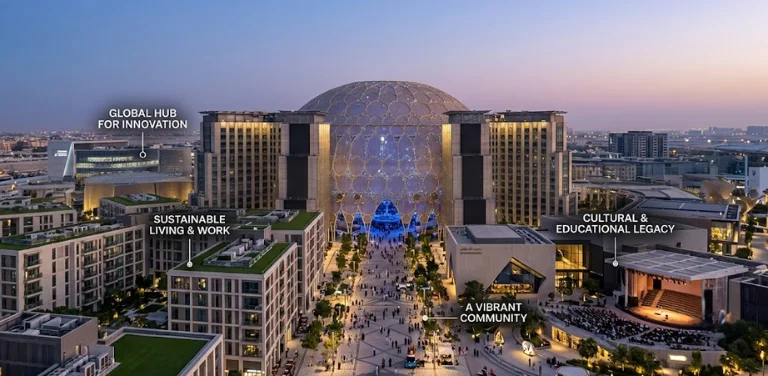
Expo City Dubai is not being positioned as a standalone residential project. It is being developed as a mixed-use urban ecosystem focused on:
- Sustainability
- Walkability
- Business activity
- Innovation
- Community living
That is a very different approach compared to older development models.
Today’s buyers and residents are not only looking for property. They are looking for complete environments that make daily life easier and more connected.
That includes:
- Shorter commutes
- Integrated communities
- Access to retail and services
- Green spaces
- Better work-life balance
Expo City Dubai is being built around those priorities, which is why it has become such an important part of Dubai’s future growth conversation.
Consumer Behaviour Is Starting To Shift

The most interesting part of this story is behavioural.
Behavioural research can help explain how changes in infrastructure, accessibility, and lifestyle preferences influence where people choose to live, work, shop, and spend their time.
As new infrastructure develops around the southern corridor, people are slowly becoming more open to living outside Dubai’s traditional central zones.
That does not mean Downtown Dubai or Marina are losing importance. It simply means buyers now have more options, and their priorities are changing.
A few trends are becoming more visible:
- Buyers are placing greater importance on lifestyle convenience
- Families are looking for larger and better-planned communities
- Professionals are becoming more open to mixed-use districts
- Residents are paying closer attention to commute quality
- Sustainability and walkability are becoming stronger decision factors
These trends can be studied through both qualitative research and quantitative research. Qualitative research can help understand why consumers value factors such as walkability, convenience, and shorter commutes, while quantitative research can identify broader patterns in residential demand, mobility, and spending behaviour.
This reflects a broader shift in Dubai real estate trends. Consumers are becoming more willing to trade central prestige for long-term lifestyle value.
Infrastructure Is Changing The Way People See Distance
One of the biggest drivers behind this shift is infrastructure psychology.
In growing cities, infrastructure changes how people mentally map the city. Once a location becomes easier to access and more connected to business and lifestyle hubs, the perception of distance changes very quickly.
That is exactly what developments around Expo City and Dubai South are doing.
The expansion of Al Maktoum International Airport is a major part of this story. Dubai Airports has announced plans for the airport to eventually support around 260 million passengers annually, making it one of the world’s largest aviation hubs.
That level of infrastructure does more than improve travel. It influences:
- Residential demand
- Business movement
- Retail expansion
- Tourism activity
- Long-term economic growth
As connectivity improves, the southern corridor starts feeling less like an “outer zone” and more like part of Dubai’s future centre of activity.
Retail And Commercial Demand Will Follow Population Movement
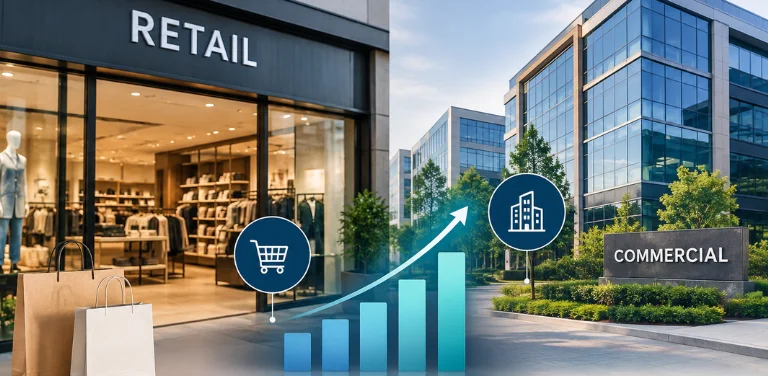
Consumer geography affects much more than housing.
For businesses, market analysis can help identify how population movement may influence retail demand, customer traffic, and opportunities for new commercial locations.
When people begin moving into new districts, businesses follow. Retail brands, restaurants, schools, healthcare providers, fitness centres, and office spaces all respond to population movement.
That is why mixed-use developments are becoming so important in Dubai.
Expo City Dubai is already positioning itself as:
- Residential destination
- Business hub
- Retail environment
- Lifestyle district
This creates a much stronger long-term ecosystem because people are not only visiting the area. They are beginning to build routines around it. That is often how new urban centres emerge.
Why This Matters For Brands And Investors
For brands, developers, and investors, this shift creates a very important signal.
B2B research can help companies understand how these changes may affect commercial demand, business expansion, partnerships, and opportunities across emerging districts.
The future of demand may not stay concentrated in the same places forever.
As Dubai continues expanding southward:
- New residential clusters will emerge
- Retail traffic patterns will evolve
- Business activity will redistribute
- Consumer movement will gradually reshape the city’s economic geography
That is why Expo City Dubai matters beyond property launches and investment headlines. It represents a larger transition in how Dubai is organising its future growth.
The real opportunity is not just understanding where construction is happening. It is understanding how consumer behaviour is changing around it.
A business intelligence platform can help bring together market, demographic, location, and behavioural data to give businesses a clearer view of these changes.
The Bigger Picture
Expo City Dubai is not simply another master-planned development. It reflects a broader shift in how Dubai is expanding, how people are choosing to live, and how future economic corridors are being formed.
The city is no longer growing around a single centre. It is developing multiple connected hubs, each influencing consumer movement in different ways. That is why consumer geography matters so much.
It helps explain not only where people are today, but where future demand, lifestyle activity, and economic momentum may move next.