
Consumer Sentiment Explained: What It Is, Why It Matters, and How Businesses Use It
Consumer sentiment describes how people feel about their finances and the wider economy, including what they expect to happen next. It gives businesses context for understanding spending decisions, but it doesn’t predict purchases on its own.
When customers hesitate to buy, a discount isn’t automatically the answer. We first need to understand whether they question the offer or feel uncomfortable spending.
Understanding consumer sentiment helps brands plan smarter, price better, and message with more confidence.
What Does Consumer Sentiment Tell Us?
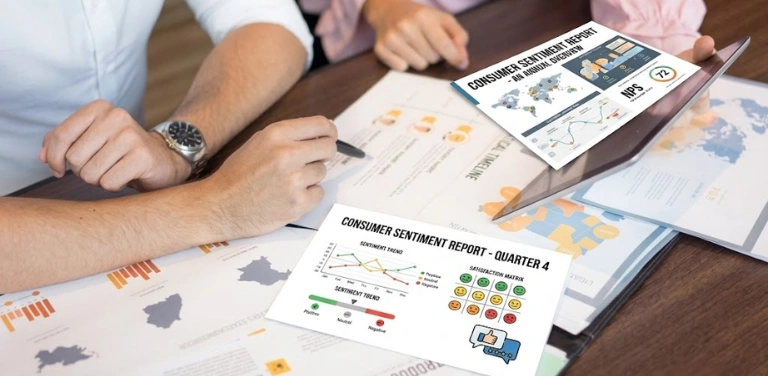
Consumer sentiment helps us look beyond whether someone can afford a purchase today. We also examine how they view their financial future.
We ask consumers how they’re managing financially and whether they expect that to change. Someone who can afford a purchase today may still put it off because they’re worried about next month’s bills.
For a business, we might investigate whether customers feel comfortable committing to a larger purchase despite having enough money available.
Being able to buy and feeling ready to buy are different questions. We need to ask both.
Consumer Sentiment vs Consumer Confidence
Consumer sentiment and consumer confidence describe closely related concepts. We check the underlying survey rather than assume the names indicate completely different measures.
The OECD’s Consumer Confidence Index considers household financial expectations and the economic outlook. It also includes views about unemployment and saving.
Neither concept means the same thing as brand sentiment. Brand sentiment concerns opinions about a particular business or its products. A customer could like your brand while feeling cautious about spending generally.
Why Consumer Sentiment Matters for Your Business
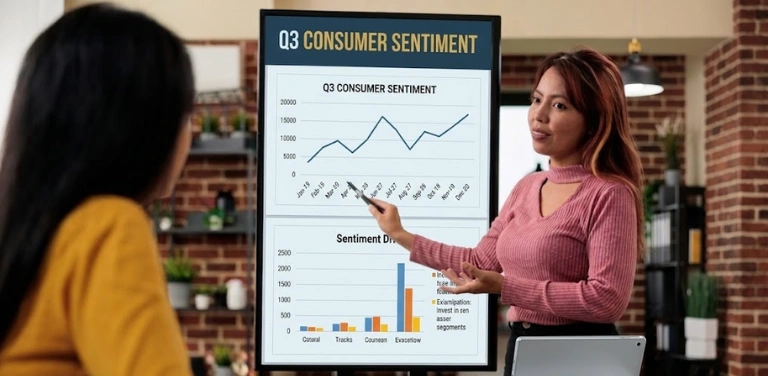
When sales slow down, we need to understand the reason before recommending a response.
A pricing problem calls for a different investigation from uncertainty about future income. Treating both as a request for cheaper products could send the business in the wrong direction.
We use research to work through practical questions:
- Are customers postponing purchases? We examine whether interest remains but the timing has changed.
- What does value mean to this audience? A lower upfront cost might matter, but we also test concerns about ongoing expenses.
- Which customers feel the most pressure? We compare relevant groups instead of treating the whole market as one audience.
- What could change the decision? We explore whether a different offer addresses the concern before recommending a wider rollout.
The aim isn’t to label consumers as optimistic or pessimistic and stop there. We need to understand what their outlook means for the decision your business faces.
What Shapes Consumer Sentiment?
Household finances and employment expectations feature in established consumer-confidence research. Views about the wider economy also form part of that picture.
For business-specific research, we turn those broad subjects into questions relevant to the audience.
| Area we investigate | Example research question |
|---|---|
| Everyday financial pressure | How comfortable does your household feel covering its usual expenses? |
| Income expectations | Do you expect your household’s financial position to improve over the next six months? |
| Employment outlook | How secure do you feel about your household’s main source of income? |
| Readiness for a larger purchase | What would make you feel comfortable committing to a major purchase? |
How We Measure Consumer Sentiment

We start with the decision the research needs to support. Understanding the national outlook requires different evidence from explaining hesitation among prospective customers.
Use Published Indices for Context
The University of Michigan’s Surveys of Consumers provides monthly research on US consumer attitudes and expectations. It offers a broader economic view rather than a forecast for an individual business.
We check the population a measure covers before applying it to a business question. We also compare readings within the same index rather than assume different providers use identical scales.
Ask Your Target Consumers
Our quantitative research uses structured surveys to examine patterns across an audience. It also supports comparisons between relevant consumer groups.
For a sentiment study, we can connect financial-outlook questions with category-specific purchase intentions.
For example, we might ask about comfort with discretionary spending, then separately ask whether the respondent plans to replace an appliance. Keeping those questions separate lets us examine the relationship without assuming one determines the other.
Explore the Reasons Behind the Answers
A survey response gives us a starting point. An interview lets us ask what the respondent means.
Through qualitative research, we explore the motivations behind consumer choices. We can follow up when someone describes a product as expensive and ask what makes the cost difficult to justify.
We might discover concern about the initial payment. Or the respondent might worry about running costs. We would test those explanations rather than treat “too expensive” as a complete answer.
Use Digital Feedback Carefully
Sentiment analysis examines written feedback to interpret the opinion it expresses. It can help researchers work through reviews and open-ended survey responses.
But we need to identify what the comment concerns. Frustration with a delayed delivery doesn’t tell us how that customer feels about the economy.
We also check who contributed the feedback before drawing conclusions about the wider audience. Research design needs to account for gaps in who we can reach and who responds.
How Businesses Use Consumer Sentiment
We make sentiment research useful by connecting each finding to a decision.
The table below shows hypothetical applications. These examples illustrate possible responses, not findings from PrizmData client projects.
| What the research suggests | What we would test next |
|---|---|
| Customers want the product but worry about the upfront commitment. | Compare a lower-cost option with the existing offer and check the commercial impact. |
| Buyers question whether a premium feature justifies its price. | Test feature preferences and willingness to pay before changing the product range. |
| Consumers worry about expenses after the purchase. | Test clearer ownership-cost information against the current messaging. |
| Prospective buyers intend to delay replacing a product. | Compare those intentions with actual orders before adjusting inventory plans. |
Pricing: Test the Objection Before Cutting the Price
Suppose an appliance retailer finds that prospective buyers worry about unexpected repair bills.
We would explore whether a stronger warranty addresses that concern more effectively than a small discount. The next step would involve testing the offers and comparing purchase response.
The useful question is not simply, “Will a lower price attract attention?” It is, “Does this offer address the reason people hesitate?”
We would also check the effect on margin. More purchases don’t automatically make an offer commercially worthwhile.
Product Decisions: Check What Customers Will Pay For
Consumer research can help us frame questions about which features deserve investment.
Our product research supports concept testing and pricing evaluation, giving teams a way to compare possible offers before committing to development.
For a hypothetical subscription business, concern about monthly commitments could prompt a test of a smaller plan. We would then examine whether it attracts additional customers or mainly encourages existing subscribers to spend less.
That distinction matters before changing the range.
Marketing: Address the Concern You Actually Find
We don’t recommend rewriting a campaign around broad assumptions about cautious consumers.
We start with the concern the research identifies. If buyers question ongoing costs, we can test messaging that explains those costs more clearly.
If they understand the offer but don’t consider the purchase urgent, repeating the same value message may not address the issue. We would explore purchase timing instead.
From there, campaign testing can help determine whether the revised message improves the intended outcome.
Demand Planning: Compare Intentions With Orders
For inventory decisions, we recommend checking sentiment findings against actual demand.
If respondents say they intend to delay purchases, we would compare that answer with recent orders. We would also check seasonal patterns before recommending a stock adjustment.
Our behavioural research focuses on how people act in real situations, providing a way to investigate the gap between stated intentions and observed choices.
What Should We Check Before Acting on the Findings?

Consumer sentiment is evidence to interpret, not an instruction to change strategy.
Federal Reserve researchers illustrated this distinction in a 2025 study linking US household responses with retail purchases. Spending remained strong between 2019 and 2024 even among participants who reported feeling worse about the economy.
Before recommending action, we work through these checks:
- Does the sample cover the right audience? We shouldn’t use feedback from current customers to describe everyone who could buy from the business.
- What else could explain the result? We examine alternative explanations before attributing a sales change to sentiment.
- Does behaviour support the stated intention? We compare what people report with purchase evidence where we can.
- What decision will the finding change? We define the proposed response and how we will evaluate it.
These checks help us keep the research tied to its purpose. AAPOR’s survey guidance similarly emphasises clear research objectives and considering whether a survey needs support from other evidence.
Conclusion: Make Consumer Sentiment Useful to Your Business
Consumer sentiment gives us context for understanding how people approach spending. Its business value comes from connecting that outlook to a specific decision, then checking what the evidence supports.
At PrizmData, we start with the question your team needs to answer. When customers hesitate, we investigate the concern before recommending a change to the offer.
That is how we move from a broad view of consumer confidence to research your team can use.
Frequently Asked Questions
What is a good example of Consumer Sentiment in action?
A sudden rise in fuel or grocery prices often lowers sentiment quickly, leading shoppers to delay big purchases and favour cheaper brands.
How often should businesses track Consumer Sentiment?
Ongoing tracking works best, since sentiment shifts with news, seasons, and economic events far more often than most businesses expect.
Can Consumer Sentiment predict actual sales?
It cannot guarantee outcomes, but falling or rising sentiment is a reliable early signal of spending changes in the following months.