
Behavioural Research Study: Usage Of Thought Leadership Content By Professionals
Thought leadership is one of those things most companies take seriously. They put real effort into it. Plenty of drafts. The right charts. The right language. The final output usually looks impressive.
And then it goes online, and the real question begins. Do professionals actually read it? Because “published” and “useful” are not the same thing.
That gap was the reason behind this behavioural research study. We wanted to understand what thought leadership looks like from the other side, from the people who are meant to consume it, while they’re busy doing actual work.
This case study brings together what we heard from professionals across roles and regions, including the client’s customers and competitor customers. The goal was understand how the content gets discovered, judged, trusted, and applied in real decision environments.
Using Behavioural Research Study To Make Thought Leadership Work Harder

Thought leadership often gets treated like a brand asset. Something that signals expertise and visibility.
But professionals don’t consume content the way brands imagine they do. They are not sitting down thinking, “Let me explore a long perspective piece today.” They are moving quickly, switching contexts, and trying to solve problems. If your content helps them do that, it lands. If it doesn’t, it becomes background noise.
That is where behavioural research studies become valuable. By looking at how professionals actually discover, evaluate, and use content, organisations can move beyond assumptions and understand what truly creates engagement and trust.
That’s why this opportunity mattered. The client knew the audience was diverse. What it needed was clarity on what “impact” actually means across that diversity.
Why Thought Leadership Often Misses Its Mark
One of the biggest issues is that different roles want different things.
A senior executive scanning a platform is not looking for the same thing as an analyst building a view or an investment professional preparing for a call. Even within the same organisation, people approach thought leadership with very different expectations.
Across interviews for this behavioural research study, it became clear that professionals typically want thought leadership to do one of a few jobs:
- Give them a clean, quick angle they can repeat in a conversation
- Help them interpret a market shift without spending hours digging
- Validate a view they already have, or challenge it thoughtfully
- Provide something credible they can forward internally
When one piece of content tries to satisfy all of those at once, it can end up sounding safe. And “safe” content is easy to skip.
What The Client Needed To Understand
The client did not need more content for the sake of it. It needed better precision.
The questions were practical:
- Where are professionals actually finding thought leadership today?
- What makes them click, or ignore it entirely?
- What earns trust quickly, and what creates doubt?
- How does thought leadership show up in real work, if it does at all?
- And when professionals compare providers, who feels more credible and why?
The Research Solution: A Behavioural Research Study

We kept the study grounded in behaviour through qualitative market research. Not “what people say they want” in abstract terms, but how they actually act when content appears in front of them.
Study Objective
The objective was simple: understand how professionals access and use thought leadership content, so it can be delivered in a more impactful way.
That meant focusing on the lived experience of content, not just performance metrics.
Who We Spoke To
The study used qualitative market research to capture detailed perspectives from professionals across different roles, industries, and regions. We conducted interviews with a balanced mix of roles, including:
- Senior executives
- Investment professionals
- Strategists
- Analysts
- Marketing leaders
The sample was global, with respondents across:
- UK
- EMEA
- North America
- Asia Pacific
We also made sure the sample included both the client’s customers and competitor customers. That matters because it forces a more honest comparison. People are rarely “loyal” to thought leadership. They follow what feels useful and credible.
What We Explored In Conversations
We explored:
- How professionals come across thought leadership (and where)
- What makes them engage beyond the headline
- How they judge credibility quickly
- What makes content feel relevant versus generic
- How content gets used inside teams and decision conversations
- How competitors’ content is perceived in comparison
What The Behavioural Research Study Revealed About Content Usage
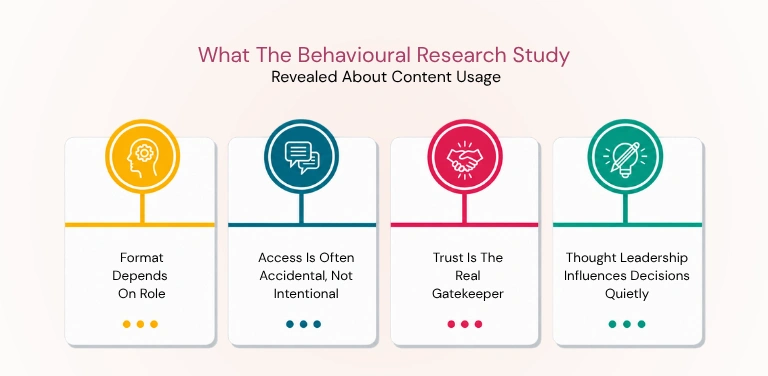
Even with differences across roles, there were patterns that came up repeatedly.
Access Is Often Accidental, Not Intentional
Most professionals are not “hunting” for thought leadership. They stumble into it through whatever channel they already use: a platform homepage, a shared link, a newsletter, a colleague’s message, sometimes even a screenshot in a deck.
So placement matters. Timing matters. Visibility matters. Quality alone is not enough if the content never gets encountered naturally.
Trust Is The Real Gatekeeper
Trust was one of the strongest themes.
Professionals are not only judging whether something sounds smart. They are judging whether it feels dependable. Whether it is grounded. Whether it is trying too hard to sell.
Signals that built credibility included:
- Clear expertise and author authority
- A balanced, non-sales tone
- Content that feels anchored to real market context
- Specificity that matches the reader’s world
Format Depends On Role
Format preferences varied sharply, and this was not subtle.
- Senior executives leaned toward shorter, clearer perspectives that help with framing and direction
- Analysts and strategists were more open to depth, provided it was structured and worth the time
- Marketing leaders looked for clarity, usefulness, and internal shareability
Thought Leadership Influences Decisions Quietly
Thought leadership does not usually walk into a boardroom and “change a decision.” That is not how it works.
But it does influence decisions in quieter ways.
Professionals use it to:
- Sense-check assumptions
- Add language and context to internal discussions
- Support points they are making to stakeholders
- Build confidence in a view before acting
Business Impact: Turning Insight Into Action

The study gave the client a clearer basis for shaping its thought leadership strategy.
Clearer Role-Based Strategy: Rather than treating the audience as one group, the client could plan content formats and delivery based on how different roles actually engage.
Stronger Focus On Trust Signals: The findings helped identify what credibility looks like to readers. This supported refinements in tone, structure, and how expertise is presented.
Better Competitive Positioning: Because perceptions were benchmarked against competitors, the client could see where it already had strength and where it needed sharper differentiation.
More Targeted Delivery: Instead of assuming distribution works, the client could rethink where and how content shows up so it is encountered in the right moments.
Closing Thought
Thought leadership is not just about publishing good ideas. It’s about being read, believed, and used.
This behavioural research study helped separate what organisations assume from what professionals actually do. That difference is where strategy becomes real.
At PrizmData, we focus on building this kind of clarity, where content decisions are grounded in real user behaviour, not internal guesswork.